

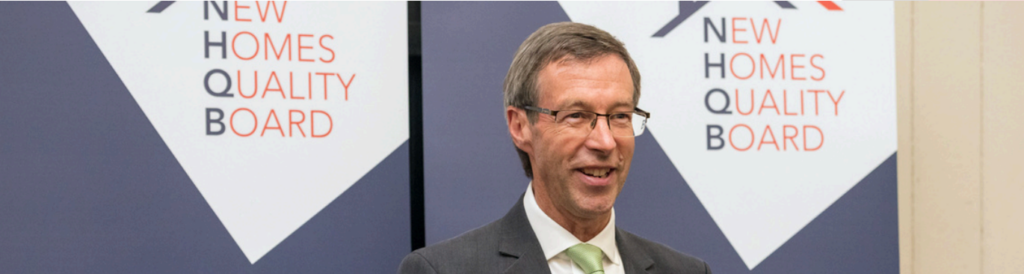
A message from Rob Brighouse, Chair of the New Homes Quality Board…
As we come to the end of another busy year for the New Homes Quality Board, this winter newsletter offers an opportunity to reflect on the progress we have made and to look ahead to 2026 with enthusiasm and a shared commitment to raising standards. Central to our work has been the continued evolution of the New Homes Quality Code. Over the past few months – and continuing into next year – we have been working with registered developers to provide support in preparing for the forthcoming updates to the Code, which come into effect on 2 March 2026. These updates are designed to further strengthen the consumer protections, improve transparency at every stage of the home-buying journey, and ensure the Code continues to set the benchmark for quality, service, and accountability across new-build homes.
Alongside this, we have been deepening our engagement with policymakers, providing evidence, insight, and practical recommendations to support a regulatory environment that prioritises consumer confidence and supports developers to raise standards. Our conversations across government and the wider housing sector remain essential to driving lasting improvement.
“In October, the NHQB also formally took on the operation of the Shared Ownership Code. This important milestone extends our reach, so that shared owners also can now benefit from greater transparency, fairness, and a more consistent customer experience.
We hope you enjoy this update, and thank you for your continued support. On behalf of the NHQB, we would also like to wish everyone a joyful Christmas and a prosperous New Year as the festive season approaches.”
– Rob Brighouse, Chair of the New Homes Quality Board
Support in preparing for the updated Code
In preparation for the Code v2, which comes into effect on 2 March 2026, we are providing you with support to help transition from the current Code v1 (October 2023) to the updated requirements.
Alongside the Transition Guide, Q&As, and our series of webinars, we have also released the new training course on the updated Code, which all customer facing teams are required to complete before the Code v2 comes into effect. We also recommend all staff complete the training to have a consistent understanding across your organisation.
This course replaces the current version and is available as a web-based resource here, or through your organisation’s learning management system.
Here is a recap of other resources available to support you on your journey. Log in to the developer portal to access these resources.
• Transition Guide
• Supporting resources and templates
• Common questions and answers
Our Code update webinars continue to be extremely popular. You can book a place on the next session using the link below. Please note that these sessions are not training; they are an opportunity to ask our industry engagement team questions about implementing the updates to the Code.
29 January 2026, 1000-1100 – click here to book
Spotlight on SMEs
NHQB continues to strengthen its engagement with smaller developers through industry forums and roundtables.
In July, our Chief Executive Emma Toms joined the All-Party Parliamentary Group for SME Housebuilders to explore how policy can better support smaller developers. These events reinforce NHQB’s mission: helping developers of all sizes embed quality and service improvements through the Code and protecting customers through the New Homes Ombudsman Service (NHOS).
NHQB’s industry engagement team, Amy Wright and Hannah Reid, are on hand to support developers in implementing the Code. With first-hand experience working within developers and implementing the Code, they understand the challenges organisations can face and can guide developers through to full compliance. If your organisation has applied but has not yet completed the process, you can contact the team at developers@nhqb.org.uk.
Customer complaints – Ombudsman & case studies
From 1 January to 25 November 2025, the New Homes Ombudsman Service received 1,328 customer complaints, with 457 new complaints accepted for investigation. It has issued 129 final decisions. Of those decisions, 20 were upheld, 24 not upheld, and 85 partially upheld.
The latest eight case studies were published on our website in October, including issues around:
- Delays in snagging repairs, poor communication, and unapproved changes to gardens and parking areas.
- Attempts to discourage customers from proceeding with purchases.
- Lack of transparency around estate agency fees, ongoing issues, and poor complaint handling.
- Flooding and damage caused by a major leak and poor repair work.
Case studies outline key learnings and recommendations to help developers improve processes and deliver better outcomes for customers. All case studies can be viewed here.

Regards